

Here’s something worth pausing on: while most of the tech world was busy dissecting the latest consumer smartphone specs or debating AI chip architectures, NEXA and Sonim Technologies quietly dropped three new products in a matter of weeks — and it might be one of the more strategically significant moves in enterprise mobility this year.
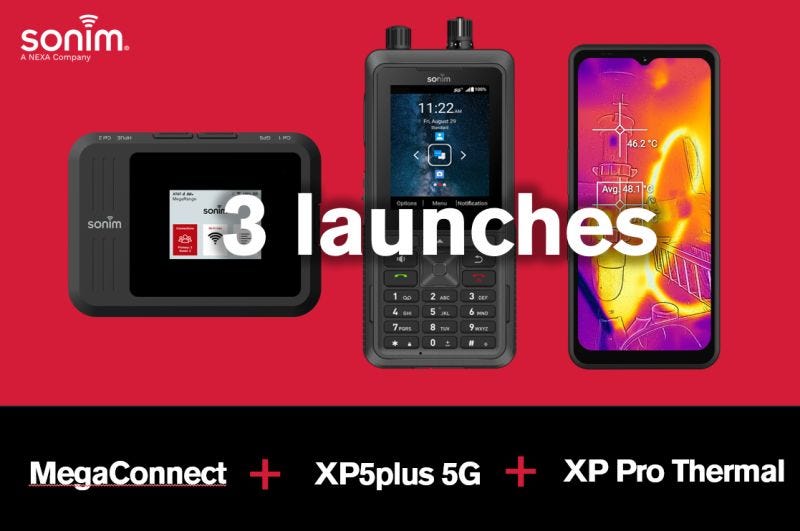
The launches — the XP Pro Thermal, the XP5 Plus 5G, and MegaConnect — came in rapid succession, and all shortly after NEXA completed its acquisition of Sonim. For an industry that tends to move at a methodical, deliberate pace, that’s notable.
A Market Bigger Than It Looks
The rugged device space doesn’t get the breathless coverage that flagship consumer phones do, but it’s a substantial and growing business. Depending on how you define the category, the global rugged phone market was valued somewhere between $3 and $6.5 billion in 2024, with analysts projecting healthy growth through the decade at CAGRs ranging from 4.5% to over 8%, driven by digital transformation in manufacturing, public safety, utilities, and logistics. The broader rugged handheld device market — which includes computers, scanners, and smartphones — sits at roughly $7.5 billion globally and is expected to approach $10 billion by 2030.
These aren’t niche numbers. And given that frontline workers make up an estimated 80% of the global workforce, the potential addressable market is enormous. In the U.S. alone, IDC projected the mobile worker population would surpass 93 million by 2024. The challenge for most of those workers isn’t access to a device — it’s access to a device that actually holds up in the field.
That’s where rugged mobility lives, and where the stakes are genuinely high.
The Long Arc of the Tough Phone
For a long time, “rugged” basically meant “won’t die if you drop it.” The early market was dominated by utilities, public safety, and the military — organizations that needed gear that could survive conditions consumer devices simply couldn’t. Durability was the whole value proposition.
Then LTE happened, and later 5G, and everything changed.
Rugged devices stopped being simple communication endpoints and became connected computing platforms. Suddenly these devices were running real-time video, push-to-talk services, field data collection, IoT integrations, GIS mapping, and increasingly, AI-assisted workflows. The device in a utility worker’s pocket became part of an operational intelligence layer that didn’t exist five years earlier.
Carriers noticed. All three major U.S. operators — AT&T, Verizon, and T-Mobile — now compete actively in the enterprise and rugged mobility space. AT&T’s FirstNet initiative has been particularly influential, building out a dedicated public safety broadband network that created demand for a whole new class of carrier-certified, prioritized, mission-critical devices. FirstNet didn’t just serve existing demand — it helped create new expectations about what rugged mobility should look like.
Three Launches, One Signal
So what’s significant about NEXA’s launch cycle?
Each of the three products speaks to a different dimension of where frontline mobility is heading.
The XP Pro Thermal is the most visually dramatic of the three. Integrated FLIR thermal imaging on a carrier-grade smartphone is genuinely rare in the U.S. market. Thermal cameras have historically required separate specialized equipment, which means extra gear, extra training, and extra steps in a workflow. Getting that capability into the same device a worker already carries has real operational value for utilities inspectors, public safety personnel, and industrial maintenance teams. It’s not a gimmick — thermal imaging is a core tool in those industries, and the friction of pulling out a separate device every time it’s needed isn’t trivial.
The XP5 Plus 5G is a less flashy but important continuation of the ultra-rugged PTT lineage. There’s a persistent assumption that touchscreen smartphones have made dedicated PTT devices obsolete, but the field reality is more nuanced. Many transportation, logistics, and emergency response teams still prioritize physical controls, long battery life, extreme audio performance, and sheer resilience under rough conditions. The XP5 Plus serves organizations where those priorities haven’t changed even as the underlying connectivity has.
MegaConnect is arguably the most strategically interesting of the three. As enterprise operations push further into distributed, remote, and vehicle-based environments, portable high-performance connectivity becomes foundational infrastructure rather than a nice-to-have. Incident command centers, remote worksites, temporary field operations — these environments need reliable hotspot solutions as much as they need reliable devices. MegaConnect suggests NEXA is thinking about the connected frontline ecosystem, not just the individual device.
The Acquisition Pace Is the Story
What makes this notable isn’t just the products themselves — it’s how fast they came after the Sonim acquisition.
Rugged mobility has historically moved slowly through the product cycle. Carrier certification is complex. Enterprise deployment timelines are long. Hardware requirements are specialized. Bringing three products to market in such rapid succession following an acquisition suggests an unusually tight integration plan and an aggressive go-to-market posture. It doesn’t feel like standard post-acquisition consolidation — it feels like acceleration.
NEXA’s stated $100 million investment commitment reinforces that reading. This isn’t a company that acquired a hardware brand and is figuring out what to do with it. They came in with a strategy.
Where the Market Is Actually Going
The broader industry dynamics are worth keeping in mind here, because they shape what winning in this space actually requires.
Consider this: eight out of ten organizations now report that frontline workers experience work stoppages due to mobile device, app, or network issues at least once a month — and more than half say it happens weekly. According to B2M Solutions’ 2025 State of Enterprise Mobility report, the cumulative cost of that lost productivity runs into the billions annually. Reliability isn’t a feature preference. It’s a business-critical requirement.
At the same time, the nature of what frontline workers are doing with their devices is getting more sophisticated. AI-assisted workflows, real-time operational visibility, edge computing integration, IoT connectivity — these capabilities are moving from enterprise pilots into standard field operations. Gartner has projected that 80% of enterprise software will be multimodal by 2030, driven by AI and mobile-first design. The rugged device that serves the frontline worker of 2028 needs to be a genuinely capable computing platform, not just a durable phone.
For carriers, this creates real strategic opportunity. Rugged mobility increasingly anchors higher-value enterprise relationships that extend across managed services, private networking, IoT platforms, and security solutions. It’s a stickier, more strategic relationship than a consumer handset contract.
For OEMs and mobility providers, that shift changes the competitive dynamics. Hardware durability remains table stakes — it’s the floor, not the ceiling. The companies that win will be the ones who build out integrated ecosystems: rugged hardware paired with secure connectivity, edge networking, AI-enabled workflows, fleet intelligence, and real-time situational awareness.
A Moment Worth Watching
NEXA’s launch momentum is a concrete signal that at least one player in this market has looked at those dynamics and decided now is the time to move aggressively.
The rugged mobility market doesn’t get the headlines it deserves given the scale of the workforce it serves and the criticality of the problems it solves. But it’s evolving quickly — from a specialized hardware segment into genuine operational infrastructure for the industries that keep everything else running.
The next wave of competition in this space may be less about who builds the toughest device, and more about who builds the most intelligent connected frontline ecosystem. NEXA is making a clear bet on which side of that line they want to be on.